Blog
What is Contango?
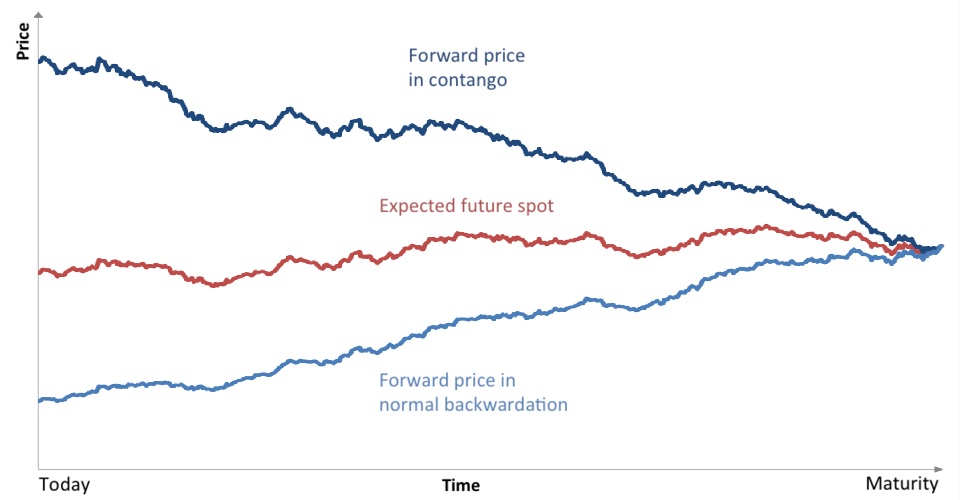
Contango refers to a case where an underlying commodity’s future price exceeds its current spot price. Contango is a bullish sign because as the price is expected to rise in the future, there are going to be more buyers willing to pay higher for it at the moment. Gold is usually in contango, for example.
It is important to note that there are certain carrying costs to take into account. This includes storage costs, insurance as well as the forgone interest on money that is tied down to that commodity. As the date of maturity draws closer, the forward price in contango shall converge downwards, moving closer to the commodity’s future spot price.
Contango manifested itself various times over the years. For instance, back in the 1970s there were the oil price shocks. Moving on to the mid-1980, the price of an oil barrel was over $100, only to fall to around$25 per barrel by 1986. By 1998 it had plunged to $14, and then by mid-2008 it exploded to some $140 per barrel! These price fluctuations can help to understand why market participants look forward to engage in contango.
Some advantages of contango include:
- Arbitrage opportunities may occur
- Ideal when inflation is rising
- It also enables investors to rebalance portfolios, and spread risks.
While with contango the forward prices are higher than the spot prices, there is also the opposite scenario, which is referred to as backwardation. In this case, the forward prices are lower than the spot prices.
Another related term is convenience yield. This refers to the return one gets from having held onto the commodities in their physical form. The convenience yield will be low is stock levels are high, and vice versa. As a trader it is important to be aware of these factors and their relationships to one another as at the end of the day they have an impact on futures prices and spot prices.
Speculators, in particular, will want to consider contango and backwardation carefully as trading opportunities are created especially at the points when the forward prices curve converges to ultimately lead the spot price.
During contango one will want to go long on futures contracts since the expectation is that the prices will continue to rise further. However as maturity date draws nearer, many will opt to go short on futures contracts since forward prices would have started to converge downwards so as to meet the spot prices.
It is important to note that there are certain carrying costs to take into account. This includes storage costs, insurance as well as the forgone interest on money that is tied down to that commodity. As the date of maturity draws closer, the forward price in contango shall converge downwards, moving closer to the commodity’s future spot price.
Contango manifested itself various times over the years. For instance, back in the 1970s there were the oil price shocks. Moving on to the mid-1980, the price of an oil barrel was over $100, only to fall to around$25 per barrel by 1986. By 1998 it had plunged to $14, and then by mid-2008 it exploded to some $140 per barrel! These price fluctuations can help to understand why market participants look forward to engage in contango.
Some advantages of contango include:
- Arbitrage opportunities may occur
- Ideal when inflation is rising
- It also enables investors to rebalance portfolios, and spread risks.
While with contango the forward prices are higher than the spot prices, there is also the opposite scenario, which is referred to as backwardation. In this case, the forward prices are lower than the spot prices.
Another related term is convenience yield. This refers to the return one gets from having held onto the commodities in their physical form. The convenience yield will be low is stock levels are high, and vice versa. As a trader it is important to be aware of these factors and their relationships to one another as at the end of the day they have an impact on futures prices and spot prices.
Speculators, in particular, will want to consider contango and backwardation carefully as trading opportunities are created especially at the points when the forward prices curve converges to ultimately lead the spot price.
During contango one will want to go long on futures contracts since the expectation is that the prices will continue to rise further. However as maturity date draws nearer, many will opt to go short on futures contracts since forward prices would have started to converge downwards so as to meet the spot prices.